Chapter 5:
Bankruptcy, Indictments & The Echo Chamber
The ultimate forensic autopsy: while retail influencers and promoters spun endless fantasies of trapped short sellers and counterfeit shares, the cold regulatory and market structure record proved the exact opposite. FINRA’s official 19-question regulatory FAQs and 2.65-million Electronic Blue Sheet (EBS) audit revealed that open short interest was a microscopic 1.6% of the float (collapsing 58.6% before the halt), 100% of aggregate shares (165.47M) reconciled directly to AST, and Keubiko’s market structure breakdown proved shorts had zero reason to cover after December 8.
As institutional autopsies from Keubiko and John Hempton deconstructed the clearing physics and Forbes exposed the cult psychology of the movement, the corporate facade disintegrated entirely: Meta Materials filed for Chapter 7 total liquidation, while the SEC charged former CEOs John Brda and George Palikaras with federal securities fraud in the Southern District of New York.
Yet the delusion never stopped. Driven by an algorithmic echo chamber on Twitter Spaces (792+ audited hours) and coordinated bot astroturfing, retail investors refused to accept they were bamboozled by corporate insiders. Faced with dismissals with prejudice in federal courts, the movement continuously moves the goalposts—cycling from Congressional hearings and veterans lobbying to paid media spots, empty dirt claims, and Blue Ledger AI pivots in an endless, relentless refusal to face empirical reality.
The Twitter Spaces Echo Chamber: Early Mobilization
Immediately following the December 9, 2022 FINRA U3 halt, daily Twitter Spaces and YouTube broadcasts erupted, constructing an alternative reality of guaranteed settlement billions and short squeeze certainty.
Rollerpigeons & $500 Targets
The most visible grassroots retail influencer. Using pigeon breeding analogies and whiteboards, she convinced thousands of retail traders that MMTLP was guaranteed to squeeze to hundreds or thousands of dollars, anchoring valuations to Rich Masterson’s ~3.2B barrel estimate and urging followers to hold for an imminent Exxon buyout.
Spaces Host & Community Mobilizer
Marine veteran influencer with over 229,000 followers who hosted massive nightly Twitter Spaces throughout 2023. Championed community fundraising, blue sheet demands, and aggressive retail mobilization before later spearheading political lobbying.
The Daily Broadcast Circuit
Dozens of YouTube channels hosted multi-hour live streams reviewing OTC charts, tracking Level 2 quotes, and amplifying speculative theories regarding DTCC synthetic short obligations and trapped hedge funds.
Activist Rallies & Media Outlets
Coordinated on-the-ground demonstrations in Washington D.C., produced slick promotional videos, and lobbied political figures, insisting that market regulators and hedge funds had stolen trillions in retail wealth.
Whenever analytical posters cited sworn SEC S-1 filings stating Next Bridge had no commercial reserves or that shares were non-DTC eligible, they were instantly muted, labeled “paid shills,” or banned from Twitter Spaces.
When the short squeeze failed, the narrative pivoted to an imminent settlement offering. When the 40M S-1 offering flopped with zero sales, the narrative pivoted to secret grand juries and Congressional subpoenas.
Influencers urged thousands of retail families to donate money to legal defense funds to sue FINRA and DTCC in federal court, assuring retail that discovery would force regulators to pay out tens of billions of dollars.
Social media platforms like Twitter/X reward engagement, anger, and confirmation bias. After the U3 halt, retail investors naturally sought answers and comfort. Influencers stepped in to provide daily hours of hope—assuring investors that billions of dollars in settlements were right around the corner. Because the community shouted down anyone pointing out the cold text of the SEC filings, investors remained locked in an emotional feedback loop while the actual corporate entities headed towards bankruptcy and court dismissals.
The Bagholder's Guide: Thomas Yeung's Day-9 Autopsy
Nine days after the U3 trading halt—while social media influencers were assuring retail investors that multi-billion dollar short-squeeze payouts were guaranteed—CFA Thomas Yeung of InvestorPlace published the earliest mainstream financial analysis exposing the corporate freeze-out playbook, Meta Materials' catastrophic cash burn, and the Next Bridge board's unilateral power grab.
IAC vs. AmTrust Financial
Yeung noted that standard corporate spinoffs (such as IAC using mandatory exchangeable preferreds to spin off Expedia in 2005) preserve public liquidity for investors. Instead, Meta Materials designed an unlisted spinoff mimicking the notorious 2018 AmTrust Financial Services privatization, which wiped out public trading and locked preferred shareholders into an unlisted corporate black hole.
The Stuffed Animals in the Attic
“The preferred stock (trading at $12.50 less than a month before the deal) is now worth about as much as the hoard of stuffed animals sitting in my attic. There's no easy way to offload them.”
While retail influencers convinced followers that shares would be redeemed for hundreds of dollars per share, Yeung recognized that untradeable registered common stock in an unlisted company carries zero secondary market liquidity.
The loss of trading was not an accidental byproduct of FINRA's halt; it was the express design of Next Bridge Hydrocarbons' S-1 filing, which explicitly notified the public that the company had no intention of ever listing on an exchange.
Outcome: Chapter 7 Bankruptcy Liquidation (Aug 21, 2024).
Outcome: 100% Illiquid uncertificated shares; zero public market.
Outcome: 100M share dilution; $10M dry hole liability.
MMTLP: You Want It to Be One Way... But It's the Other Way
On May 09, 2023—exactly six months after the trading halt—veteran capital markets analyst Keubiko published the first comprehensive market structure autopsy of MMTLP. Grounded strictly in T+2 settlement physics, official exchange short interest data, and federal clearing regulations, Keubiko methodically dismantled the foundational myths of the retail community, proving why short sellers had zero economic reason to cover after December 8 and why FINRA's halt prevented the predatory dumping of valueless canceled shares onto innocent buyers.
The Marlo Stanfield Law: Market Reality vs. Retail Conviction
Why clearing calendars and legal definitions cannot be negotiated by social media consensus.
“You want it to be one way… But it's the other way.”
Keubiko adopted Stanfield's chilling aphorism to summarize the collective psychology of MMTLP holders: no matter how desperately retail investors wished that trading would resume, that shorts were legally forced to cover, or that settlement rules would bend for their short squeeze, Wall Street's legal and clearing infrastructure operated strictly under federal laws that made their demands impossible.
“Money ain't got no owners, only spenders.”
In capital markets, retail capital lost to speculative reverse-merger promotions does not sit in an escrow account waiting to be returned by Congress. It was spent—extracted by Torchlight insiders via $137.5M ATM offerings, absorbed by market makers maintaining orderly bids, and locked into an unlisted private company holding zero certified proved reserves.
The T+2 Clearing Calendar Matrix (Dec 6 – Dec 14, 2022)
Interactive day-by-day mapping of trade execution dates, two-day settlement arrival, and delivery rights.
FINAL TRADING DAY FOR DISTRIBUTION
Final trades entitled to receive Next Bridge shares.
Final day for shorts to cover and eliminate NBH liability.
Last day to sell for cash or buy for NBH shares. Panic selling cascades into market close. Closes at $2.90. After 4:00 PM, all positions are irrevocably locked.
The 8 Institutional Market Structure Axioms
Methodical refutation of the core conspiracy theories propagated across Twitter Spaces.
The Marlo Stanfield Law: T+2 Settlement Physics & The Dec 8 Cut-off
““You want it to be one way… But it’s the other way.” - Marlo Stanfield, The Wire. Stocks trade on what is known as "T+2 settlement". All of the dates and details above were known by December 6. December 8 was always the date by which you had to sell MMTLP to receive cash instead of the NBH shares. Regardless of what FINRA did or didn’t do after December 8, if you didn’t sell by end of day on the 8th, those NBH shares were coming your way whether you wanted them or not. You will not get "two days back". You will not get two seconds back.”
FINRA Corporate Action Notice (Dec 6, 2022) & Meta Materials Press Release (Dec 7, 2022). Trades executing Dec 8 settled on Monday Dec 12 (Record Date). Anyone holding shares at market close on Dec 8 had irrevocable rights and obligations to receive Next Bridge common shares.
You cannot bend clearing calendars just because you are losing money. If you held past 4:00 PM on Thursday Dec 8, you bought an untradeable private oil company, period. FINRA halting Friday did not trap you—your own decision not to sell did.
Community Myth vs. Market Structure Reality
Side-by-side contrast between online influencer dogma and real clearing mechanics.
“FINRA stole two days of trading from us! We were promised trading through December 12!”
“You will not get ‘two days back’. You will not get two seconds back. You have everything you are entitled to (a non-trading share of NBH).”
Under T+2 settlement, purchases on Dec 9 settled Dec 13 (the cancellation date), and purchases on Dec 12 settled Dec 14. Allowing trading would have created an immediate systemic clearing fail where buyers paid cash for shares that were deleted before delivery.
“Short sellers were trapped and would have been forced to cover at thousands per share on Dec 9 & 12!”
“After December 8, covering MMTLP would have been a waste of money for a short seller... any price above $0.00 would be free money for any new short seller.”
Short seller liability for the NBH spin-off attached permanently at market close on Dec 8 (Record Date settlement cutoff). Buying an empty MMTLP shell on Dec 9 would not satisfy NBH liability, and canceled shares are closed at zero cost on prime broker books.
“Daily short volume was 50% to 70% every day, proving billions of synthetic counterfeit shares!”
“The vast majority of reported ‘daily volume’ has nothing to do with actual short selling by short sellers. It’s simply market mechanics of how trades are executed.”
FINRA Information Notice 051019 explicitly warns that daily short sale volume reflects market makers providing liquidity by shorting to execute a buy order before immediately buying back to flatten position. Official short interest was only 4.6M shares (2.8%).
“My broker gave me a weird placeholder number instead of a real CUSIP! It proves my shares are fake!”
“Most, if not all, of this confusion stems from a lack of understanding about how securities are held and registered at brokerage firms... in ‘street name’.”
Next Bridge is an unlisted private company with no DTC depository eligibility. Brokerages assign internal alphanumeric placeholder codes to track client positions on their internal ledgers while shares are registered in street name at AST.
“In conclusion, if you feel that you've been ‘done dirty’, you really only have yourself, and possibly some people that fed you misinformation, to blame. You will not get ‘two days back’. You will not get two seconds back. You have everything you are entitled to.”
The Official FINRA Record: 19 Questions, 2.65M Short Positions & The Clearing Reality
Across two definitive technical releases published on March 16, 2023 and November 06, 2023, the Financial Industry Regulatory Authority (FINRA) broke its institutional silence. Grounded in exhaustive Electronic Blue Sheet (EBS) transaction audits and transfer agent records, FINRA dismantled every foundational claim of the online community—proving that open short interest was barely 1.6%, delivery fails were virtually nonexistent (0.03%), all 165.5 million shares were accounted for, and Next Bridge’s illiquidity was manufactured entirely by its own corporate architects.
The Empirical Audit: Hard Numbers from the Regulatory Record
Federal regulatory data contradicting the “hundreds of millions of counterfeit shares” narrative.
Official aggregate short positions across all broker-dealers on final settlement date. Down 58.6% from mid-Nov.
NSCC Continuous Net Settlement logs proved failure-to-deliver was microscopic. Brokers had borrows for ~100% of shorts.
Transfer agent AST distributed the exact number of shares specified in the S-1 prospectus. Zero share disparity identified.
Trading originated via unsolicited customer orders (Rule 15c2-11(f)(2)). FINRA assigned symbol strictly for trade reporting.
The Rapid Evaporation of Short Interest Ahead of the Freeze
Online promoters claimed short sellers were trapped with hundreds of millions of uncovered synthetic positions. In reality, FINRA's Electronic Blue Sheet regulatory audit revealed that short sellers spent the final four weeks aggressively buying to cover, collapsing open short interest to a mere 1.6% of the company:
Exchange-reported short interest as retail speculative buying drove MMTLP toward $12.50.
Short sellers aggressively buying to cover and close positions before the Dec 8 corporate cutoff.
Official Electronic Blue Sheet aggregate short audit across all broker-dealers on final settlement date.
In footnote 13 of the Supplemental FAQ, FINRA cited the SEC's staff study of the 2021 meme stock events: GameStop (GME) had open short interest exceeding 109.26% of its entire outstanding float. MMTLP, by contrast, had short interest of just 1.60% on settlement day. The premise of an “unprecedented short squeeze” was mathematically nonexistent.
Interactive 19-Question Regulatory Explorer
Inspect verbatim answers, governing statutory bases, conspiracy theories refuted, and layman takeaways.
FINRA determined an extraordinary event occurred creating significant uncertainty in settlement and clearance. After Dec 12, MMTLP ceased to be DTC-eligible; shares were scheduled for cancellation on Dec 14; and Next Bridge was not DTC-eligible. Had trading continued past Dec 8, buyers would pay cash for shares canceled prior to delivery without receiving the Next Bridge distribution.
“FINRA halted trading corruptly to protect short-selling hedge funds from an infinite squeeze.”
FINRA pulled the emergency brake because buyers on Friday would have paid dollars for shares that were deleted before delivery, leaving them with nothing.
Securities transactions settled under SEC rules on a two-business-day cycle (T+2). Trades executed on Dec 8 settled on Dec 12 (the Record Date). Trades executed on Dec 9 or Dec 12 would settle on or after Dec 13. A purchaser only becomes a holder of shares upon settlement. Therefore, only trades executed on or before Dec 8 could settle in time to receive Next Bridge shares.
“Retail was entitled to trade through Monday, Dec 12 and still receive Next Bridge shares.”
Stock purchases in 2022 took two business days to settle. Buying on Friday Dec 9 meant delivery on Tuesday Dec 13—one day after the record cutoff. You arrived too late for the dividend.
Yes. Meta Materials distributed 165,472,241 shares on a 1-for-1 basis through transfer agent American Stock Transfer & Trust (AST)—the exact share count anticipated in the S-1 prospectus. Public information reflects zero disparity between MMTLP shares outstanding and Next Bridge shares distributed.
“Brokers and transfer agents oversold the company by hundreds of millions of shares.”
The transfer agent handed out exactly 165,472,241 shares—the exact number registered with the SEC. Not a single extra or missing share was found.
Based on subsequent regulatory audits across all broker-dealers, aggregate short interest as of Dec 12, 2022 was approximately 2.65 million shares—just 1.6% of total shares outstanding. Short interest collapsed nearly 60% from 6.4 million on Nov 15 and 4.7 million on Nov 30.
“Short sellers held 50 million to 300 million uncovered short positions at the freeze.”
The government audited every single brokerage firm and discovered that total open short interest at the freeze was only 2.65 million shares—barely 1.6% of the company.
FINRA found no evidence of significant naked short selling. Fails-to-deliver (FTDs) on Dec 9 were only 215,238 shares. For Dec 12 settlement, potential FTDs were estimated at an infinitesimal 0.03% of shares outstanding. Broker-dealers had stock borrows or margin securities available to cover virtually 100% of open short positions.
“An illegal naked shorting syndicate printed millions of phantom synthetic shares.”
Official SEC clearing records proved delivery failures were almost nonexistent (0.03%). Brokers had borrowed shares lined up for nearly 100% of all short positions.
The 4 Corporate Choices That Locked Shareholders Out of Secondary Markets
Social media influencers claimed FINRA or the SEC “embargoed” Next Bridge shares from trading. In Questions 11 and 19, FINRA stated the plain truth: Next Bridge common stock is non-trading solely because the company’s own management chose not to take the required legal steps to support public quoting:
No DTC Eligibility
Next Bridge explicitly stated in its Form S-1 registration statement that it would not seek DTC eligibility, intentionally cutting itself off from the central electronic clearinghouse.
No CUSIP Number
Next Bridge never applied for or obtained an official security identifier from CUSIP Global Services, preventing brokerages from tracking the asset in a standardized format.
No Trading Symbol
Without a CUSIP number, broker-dealers are legally precluded under FINRA rules from requesting an OTC trading symbol to support secondary market quotations.
Ex-Clearing Only
Because shares cannot clear electronically through NSCC Continuous Net Settlement (CNS), any theoretical transfer requires slow, expensive, manual physical book transfers at AST.
“The information made available publicly by Meta Materials and Next Bridge... does not reflect a disparity between the number of MMTLP shares the company understood to be outstanding and the number of Next Bridge shares distributed... and FINRA has not identified any information indicating otherwise.”
Attack of the Naked Short Sellers: How Meme-Stock Investors Went “Cult-y”
On December 27, 2023—the exact one-year anniversary of the FINRA trading halt—Forbes published a landmark non-fiction graphic novel exposé by financial journalists Bob Ivry and Brandon Kochkodin, illustrated by renowned French artist Yvan Guillo (Samplerman). The comic diagnosed the psychological mutation of the retail movement: how 64,000 investors smoked so much “hopium” they turned an unviable desert land gamble into an insular cult.
“It’s easier to fool people into believing they’ll make piles of money than it is to convince them they’ve been fooled.”
— Bob Ivry & Brandon Kochkodin, Forbes (Dec 27, 2023)
Forbes was the first major national publication to explicitly identify that MMTLP had crossed over from an investment into an insular, high-control social cult that punished analytical dissent and operated entirely on faith.
By calling naked short sellers “mythical beasts of the night” and “make-believe enemies,” Forbes struck at the core theological pillar of the movement. Influencers spent months organizing targeted social media harassment against reporter Brandon Kochkodin.
Within seven months of publication, Forbes was 100% vindicated: the SEC indicted Brda and Palikaras in SDNY for the very market manipulation depicted in the comic, and Meta Materials collapsed into Chapter 7 bankruptcy liquidation.
The Interactive Comic Archive: All 14 Published Panels
Click thumbnails to change panels. Use zoom and view modes below for high-resolution reading.
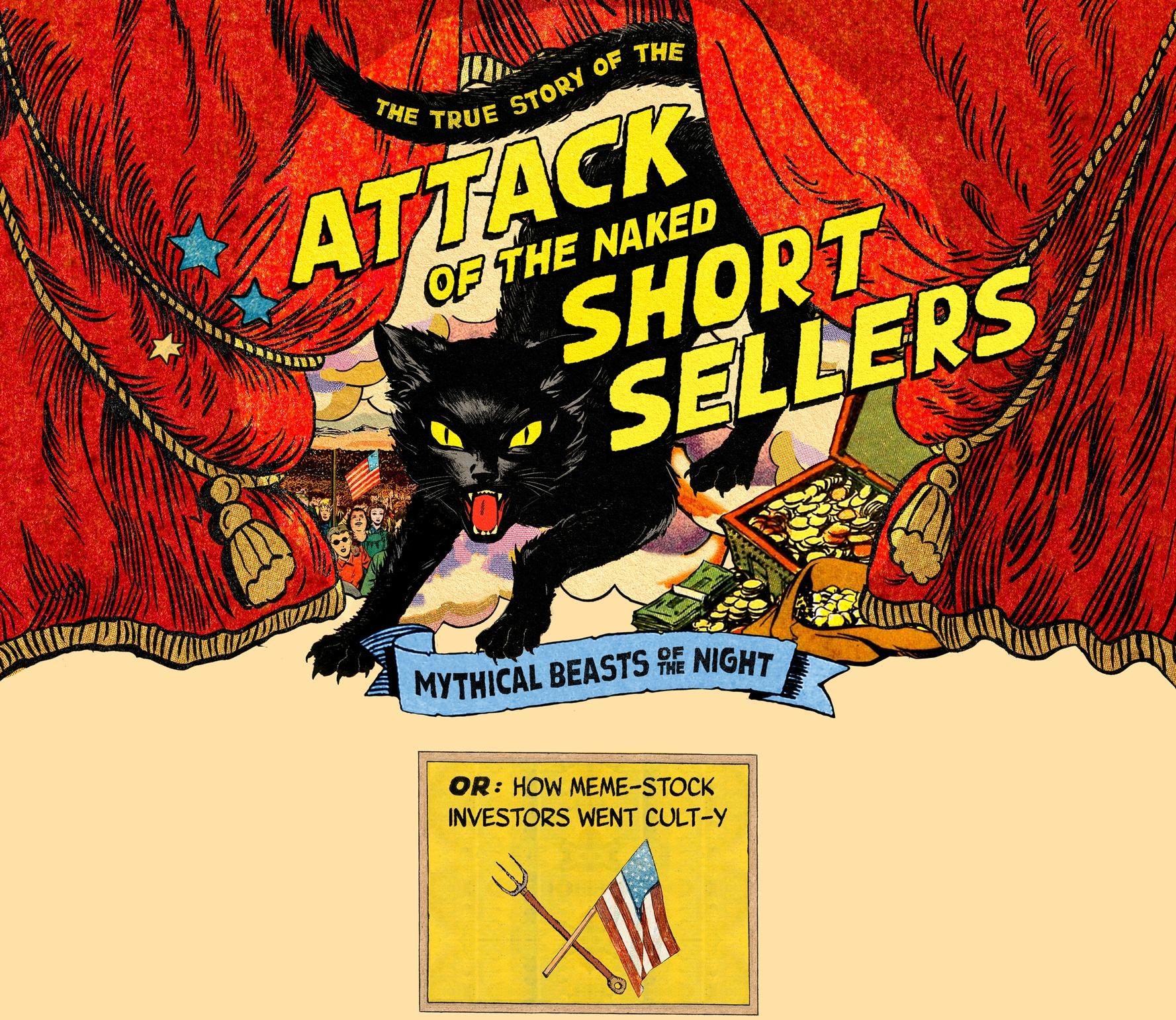
“To paraphrase Mark Twain, it’s easier to fool people into believing they’ll make piles of money than it is to convince them they’ve been fooled.”
“Here’s the true story of stock investors who smoked so much "hopium" they lost their shirts — and their minds.”
“Story by Bob Ivry and Brandon Kochkodin. Illustrations by Yvan Guillo/Samplerman.”
Published on Forbes on December 27, 2023, exactly one year post-halt, marking the first nationwide mainstream financial exposé diagnosing the movement as an insular cult.
Retail traders were trapped in psychological sunk-cost bias: it was emotionally easier to believe an international regulatory conspiracy than to admit corporate executives fooled them.
13,000 Unsealed Records, The Parody Subpoena & The FOIA Siege
When court dockets unsealed and transparency petitions were adjudicated, discovery revealed operational clearing panic, self-inflicted perjury traps by corporate insiders, and the statutory reality of federal law enforcement exemptions.
Operational Panic, Not Collusion
Litigation unsealed over 13,000 internal emails and chat messages between FINRA, DTC, and clearing brokers between Dec 6 and Dec 9, 2022. They revealed operations desks frantically realizing that Meta's published corporate action dates made T+2 clearing mathematically impossible.
The Settlement Void
Brokers flagged that uncertificated Next Bridge shares could not be delivered to buyers executing trades on December 9 or 12. Allowing trading to continue would have created tens of thousands of irreconcilable fails-to-deliver into a cancelled and unquoted private CUSIP.
Across 13,000 unsealed communications, FINRA market operations specialists repeatedly inquired whether the company would amend its S-1 distribution dates to allow an ex-dividend trading market. Next Bridge management refused to delay the corporate action, forcing the regulatory freeze.
SEC v. John A. Brda & Georgios Palikaras
On July 25, 2024, the SEC filed civil fraud charges in federal court in Manhattan, unsealing sworn evidence that the 2021 Torchlight squeeze was an orchestrated market manipulation scheme.
Engineering the Dividend Lure
The SEC established that John Brda invented the Series A Preferred dividend placeholder specifically to entice retail traders into a buying frenzy. Internal records prove defendants knew the oil assets had zero commercial buyers and had suffered -$111.9M in operating deficits.
Secret $137.5M ATM Extraction
While Palikaras posted viral tweets like “Torch the Shorts” and hyped retail buyers on YouTube, Torchlight quietly executed an At-The-Market (ATM) stock offering, dumping 16.2 million newly minted shares directly into retail buy orders to extract $137.5 million in cash.
The $2.25M Personal Bounty
Upon consummation of the reverse merger, John Brda walked away with a $2.25 million cash severance payment and millions in common shares. Greg McCabe was notably excluded from the SEC fraud complaint, maintaining his unindicted status as an operational producer.
In federal court, the SEC laid out the entire sequence in black and white: Torchlight was an insolvent oil penny stock facing imminent Nasdaq delisting. Rather than going bankrupt in 2020, management cooked up a reverse merger, teased an “oil dividend” that did not exist in reality, pumped the stock on social media, dumped $137.5 million worth of stock on retail buyers at the peak, and paid themselves millions in bonuses before the entire house of cards collapsed.
Meta Materials Enters Chapter 7 Bankruptcy
On August 21, 2024, the reverse merger experiment officially died. Meta Materials filed for Chapter 7 liquidation in Nevada, wiping out 100% of common equity. Behind closed doors, an insider war erupted between Greg McCabe and George Palikaras to strip the remaining assets.
Liquidation, Not Reorganization
Meta Materials did not file under Chapter 11 to restructure debt or continue operating. It filed under Chapter 7—which mandates immediate termination of all business, firing of staff, and appointment of a trustee to auction off office equipment and IP.
$0.00 for Common Shareholders
Under federal bankruptcy priority rules, senior secured creditors, debenture holders, and bankruptcy attorneys receive all liquidation proceeds before equity holders. Common shares of MMAT were canceled with exactly zero dollar recovery.
-$620M Lifetime Cash Burn
Across its entire public lifespan from the June 2021 reverse merger through the August 2024 filing, Meta Materials recorded 0 profitable operating quarters, lost over $620 million in shareholder capital, and executed repeated toxic dilutive offerings.
In 2021, retail investors were told that combining Torchlight Energy with Meta Materials was a masterstroke of financial engineering that would trap short sellers and build a multi-billion-dollar tech conglomerate. Three years later, the company ran completely out of money, could not pay its rent or payroll, and turned over its keys to a bankruptcy court liquidator. The $137.5 million extracted from retail during the June 2021 meme pump was entirely burned.
The History of BaileyBridge, Inc., McCabe's Sworn Declaration & Palikaras's Proofs of Claim
While retail shareholders organized letter-writing campaigns and hoped for a miraculous court bailout, the primary corporate insiders who engineered the Torchlight and Meta Materials transactions were locked in a ruthless bankruptcy scramble to protect themselves and claim the remnants of the estate.
What is BaileyBridge, Inc.?
BaileyBridge, Inc. is a private Nevada shell corporation formed by Gregory McCabe (Chairman and largest shareholder of Next Bridge Hydrocarbons). Incorporated on July 14, 2024, BaileyBridge executed a confidential Tolling Agreement with Meta Materials on July 17, 2024—just 34 days prior to the Chapter 7 bankruptcy filing.
To acquire the bankruptcy estate's litigation causes of action and avoidance claims under Bankruptcy Code §§ 547 & 548. By buying the claims, McCabe would control all potential clawback litigation against Next Bridge, himself, and allied insiders.
The $24M Debt Default & Pretext
In his sworn bankruptcy declaration, McCabe disclosed that when Next Bridge was spun off, it carried $24,000,000 in pre-spinoff operating debt owed to Meta Materials. On August 7, 2023, McCabe agreed to pay $6.0M cash upfront plus $5.5M over 15 months to settle this debt.
McCabe paid only September and October 2023 ($500,000 total) and stopped. On May 13, 2024, Meta Materials served McCabe a formal Notice of Default. In court, McCabe claimed “fraudulent inducement”—an excuse directly refuted by the unconditional contract terms.
Palikaras Claims $6.27 Million
While retail MMAT shareholders received $0.00, former CEO George Palikaras filed five separate proofs of claim attempting to position himself as a senior unsecured creditor to strip whatever cash remained in the estate before liquidation.
$3.67M via Lamda Guard Technologies Ltd. (alleged IP/patent loss), $1.35M personal compensation/severance, and $1.25M+ in D&O defense indemnity to pay his criminal/SEC defense lawyers.
Forensic Comparative Matrix: McCabe's Sworn Pretext vs. Contractual Ground Truth
Cross-referencing Gregory McCabe's sworn Chapter 7 declaration against the unredacted August 7, 2023 Debt Settlement & Stock Purchase Agreement.
| McCabe Sworn Testimony | Actual Contract Terms (Aug 7, 2023) | Forensic Judicial Fact Check |
|---|---|---|
“Palikaras Termination” McCabe testified he halted payments because George Palikaras was terminated as CEO in November 2023, claiming this “fraudulently induced” him. | Section 2.1: Absolute Obligation Contains zero management continuity covenants or executive retention clauses. Payment obligations were unconditional and irrevocable. | Legally Dispositive Personnel changes do not void commercial debt settlements. McCabe walked away from a binding $5.0M legal debt obligation without contractual grounds. |
“Proposed 100:1 Reverse Split” McCabe claimed Meta Materials breached faith by proposing a 100:1 reverse stock split to regain Nasdaq compliance. | Standard Corporate Powers The agreement granted Meta full board discretion over corporate capital structure and Nasdaq listing compliance. | Post-Hoc Pretext Reverse stock splits are standard corporate actions that adjust share ratios proportionally without altering net asset value. |
“Hiring Bankruptcy Counsel” McCabe testified he withheld funding because Meta Materials consulted restructuring and bankruptcy attorneys in late 2023. | Solvency Covenants Absent The contract provided no clause releasing McCabe if Meta experienced cash insolvency. | Self-Fulfilling Default McCabe withholding the agreed $500,000/month directly accelerated Meta's cash insolvency, contributing to the August 2024 Chapter 7 collapse. |
Jeff Davies Proved 100% Right Under Oath
On May 13, 2024, energy analyst Jeff Davies (@EnergyCredit1) publicly revealed on X that Greg McCabe was in formal default on his multi-million-dollar debt settlement agreement with Meta Materials.
MMTLP retail influencers attacked Davies relentlessly, branding him a “paid short-seller shill” spreading fake news. McCabe's own sworn bankruptcy declaration now confirms that Meta Materials indeed served McCabe with a formal Notice of Default on that exact date (May 13, 2024). Davies' reporting was completely factual.
Judge Gary Spraker Denies BaileyBridge Buyout
In an oral bench ruling delivered in Las Vegas, U.S. Bankruptcy Judge Gary Spraker denied Chapter 7 Trustee Christina Lovato's motion to sell the estate's adversary and avoidance claims to McCabe's shell entity BaileyBridge, Inc. for $250k + 20%.
The Court upheld shareholder pro se objections filed by Danielle Spears (Doc #3007) and Scott Traudt (Doc #2990), ruling that selling estate claims to an insider through an unadvertised sweetheart deal without an open, competitive auction violated fundamental bankruptcy principles.
While retail investors held rallies, signed petitions, and spent years believing they were part of an epic crusade against illegal naked shorting, the executives who ran the show were actively bailing out. Greg McCabe walked away from $5.0 million in owed payments and set up a shell company to buy back the lawsuits against himself for pennies on the dollar. Meanwhile, George Palikaras filed $6.27 million in bankruptcy claims to take whatever cash was left before the doors were locked forever. Retail received zero dollars and zero recourse.
Sidewalk Activism & The Paid PR Wire: Staging Demands Outside the SEC
Following federal court dismissals with prejudice and the corporate bankruptcy of Meta Materials, community promoters transitioned from financial analysis to political activism. On January 6, 2026, a paid PR Newswire press release announced a protest outside SEC Headquarters in Washington, D.C., organized by American Made Action and hosted by populist media commentator Ann Vandersteel.
Syndicated via Yahoo Finance & Financial Portals • January 6, 2026
“This is a paid press release. Contact the press release distributor directly with any inquiries. PR Newswire.”
“MMTLP Investors to Hold Press Conference at SEC Demanding Accountability for Historic Market Failure”
WASHINGTON, Jan. 6, 2026 /PRNewswire/ — Retail investors impacted by FINRA's unprecedented U3 halt of MMTLP will hold a press conference on January 12, 2026, at 10:00 AM outside the U.S. Securities and Exchange Commission to demand transparency, accountability, and enforcement action following what they describe as a regulator driven market failure.
The press conference is being organized by American Made Action, and will be led by Ann Vandersteel, Co-Founder of American Made Action and Host of Steel News...
When retail investors saw this announcement on Yahoo Finance, many celebrated that mainstream financial journalism was finally covering the “MMTLP fraud.” In reality, PR Newswire is a commercial wire service where anyone can publish any statement for an upfront fee (typically $800 to $2,000). Major portals like Yahoo Finance automatically republish thousands of paid press releases every day via automated syndication scripts. No journalist at Yahoo Finance or Bloomberg wrote or verified this release. It was paid marketing disguised as a news report.
The Press Release Demands vs. The Sworn Regulatory Record
Comparing the 4 core demands made on the SEC sidewalk against primary court dockets and FINRA audits.
“Immediate public disclosure of communications between the SEC, FINRA, market makers, and broker dealers related to MMTLP.”
Organizers claimed regulators and market makers operated in secret backrooms to coordinate a halt designed to bail out trapped institutional short sellers.
Over 13,000 internal FINRA, broker-dealer, and DTC emails, instant messages, and phone logs were unsealed in federal court discovery (e.g., Roeser v. FINRA). These records revealed that clearing firms and regulators were scrambling to interpret Meta Materials’ defective corporate action, where common stock was canceled and transferred into Next Bridge Hydrocarbons—an unlisted, non-DTC eligible private company with no trade clearance mechanism.
The secret communications they demanded had already been unsealed in federal court. Instead of a Wall Street bailout conspiracy, the emails showed market operators panicking because the company designed an impossible corporate transfer that broke normal clearing rules.
Key Figures & The Media Machinery: Who Led the Demonstration?
Broadcasts on alternative networks and Rumble. Co-founded American Made Action to mobilize grassroots populism against federal regulatory agencies. By October 2026, Vandersteel took to X to defend John Brda, George Palikaras, and Greg McCabe as “transparent” and fighting for retail.
An activist organization focusing on populist causes, election reform, and institutional accountability. Provided the operational apparatus and political branding to organize the permit, podium, and audio outside SEC Headquarters.
Grassroots retail figures who had spent years amplifying the short squeeze theory across Twitter Spaces. Delivered emotional speeches recounting frozen accounts, alleged institutional fraud, and the demand for immediate financial restitution.
Why Protest the Regulator That Prosecuted the Fraud?
The January 12, 2026 SEC sidewalk demonstration represents the psychological pinnacle of escalating commitment and cognitive dissonance in meme-stock communities. When corporate filings revealed zero commercial oil reserves, court dismissals established FINRA's lawful immunity, and the SEC charged former executives with orchestrating a fraudulent pump-and-dump, admitting the truth meant acknowledging that retail investors had been conned by penny-stock promoters.
By shifting the blame onto “regulator-driven market failure” and organizing street protests outside the regulatory agency, promoters offered retail investors an emotionally comforting alternative: they were not victims of an insolvent reverse-merger shell, but heroic whistleblowers fighting a corrupt government apparatus. The paid PR Newswire release and sidewalk speeches ensured the grift could continue uninterrupted into 2026.
MetaMaterials and Nextbridge Hydrocarbons: A Retail Fleece for the Ages
On September 12, 2026, famed global hedge fund manager and Bronte Capital CIO John Hempton published a definitive forensic autopsy of the MMTLP collapse. Holding zero financial position in the ticker, Hempton dissected the T+2 settlement mechanics, exposed why trading on December 9, 2022 would have broken the national clearing system, cited the SEC’s finding that Torchlight manufactured the squeeze, and explained why 74 Members of Congress were deceived by an astroturfed lobbying campaign.

“A Retail Fleece for the Ages — Alas They Blame the Wrong People”
John Hempton is the founder and Chief Investment Officer of Bronte Capital, a Sydney-based global hedge fund. Renowned across global capital markets for unmasking accounting frauds, predatory microcap schemes, and reverse-merger promotions before they implode, Hempton intervened in the MMTLP discourse on September 12, 2026.
“I am a short-seller and I look at ways crooks rip off retail investors in financial markets. That is - in my business - the main source of idea generation. And so I am going to tell the story about MetaMaterials Series A preferred stock ($MMTLP) and Nextbridge Hydrocarbons. This was a retail fleece for the ages and - with intense lobbying - 74 Members of Congress (68 Republicans, 6 Democrats) have become at least lightly involved in trying to find some redress for victims.”
The Reading Comprehension Test: Meta’s Dec 7, 2022 Press Release
The disclosure that retail influencers misread, ignored, or deliberately misrepresented to followers.
“MMTLP shareholders with settled positions as of 12/12/22 Record Date will receive one (1) share of Next Bridge Hydrocarbons, Inc. for every one (1) share of MMTLP held on Pay Date of 12/14/22. Purchases of MMTLP executed after 12/8/22 will not receive the distribution. Will not be quoted Ex. [NO EX-DIVIDEND DATE] MMTLP shares will be canceled effective 12/13/22.”
“What is the last day that $MMTLP will be traded?” If a buyer executes a trade on Friday, December 9 under standard T+2 settlement, that trade must settle on Tuesday, December 13. But on December 13, the shares are permanently canceled and deleted. You cannot settle a trade for shares that no longer exist.
Why Trading on December 9 Would Have Broken the National Clearing System
Stock clearing in the United States operated under standard T+2 settlement (Trade Date plus 2 business days). When a company announces a hard cancellation date, trading must halt two business days prior:
FINRA processes corporate action on OTC Daily List. PR explicitly announces: "Will not be quoted Ex. [NO EX-DIVIDEND DATE] MMTLP shares will be canceled effective 12/13/22."
T+2 settlement means trades executed today settle on Monday, Dec 12 (the Record Date). Over 85M shares traded in final 47 sessions. Closes at $2.90.
Stock CANNOT be quoted Ex-dividend. Under T+2, a trade on Dec 9 would settle on Tuesday, Dec 13—the exact day shares are cancelled and wiped out.
Trades executed on or before Dec 8 are settled and recorded on AST books. Non-DTC direct-registration cutoff established.
The Series A Preferred security is extinguished in its entirety. The ticker symbol MMTLP is deleted from the OTC system.
Next Bridge common stock (1:1 ratio) distributed via book-entry through American Stock Transfer & Trust (AST) as an unlisted private entity.
Hard Empirical Realities from an Institutional Short Seller
John Hempton’s newsletter analyzed the trade not from emotional sympathy, but through the objective lens of securities law, clearing infrastructure, and forensic short-selling:
The T+2 Math Problem: Clearing Physics, Not a Conspiracy
“A trade on 9 December could not possibly be settled on 13 December... because the shares would be cancelled by the delivery date. That is how T+2 settlement works. There is no conceivable way within current architecture to have stock trade on 9 December and settle it... the stock will have ceased to exist.”
FINRA Rule 6490 & Uniform Practice Code: Broker-dealers cannot execute transactions where the settlement date succeeds the corporate extinction date without creating unreconciled delivery failures.
If you buy milk at a store, the milk has to exist when they hand it to you. If the company deleted the shares on Tuesday, you cannot buy them on Friday with a 2-day delivery rule. If FINRA allowed trading on Dec 9, buyers would have paid money for literal nothing.
The Ultimate Irony: Who Really Defends Market Integrity?
Retail advocates claim they are “fighting for market integrity” by demanding that FINRA resume trading on an extinguished OTC symbol, force short-sellers to buy unlisted non-DTC private stock, and break settlement timelines to manufacture an artificial squeeze.
Allowing shares to trade on December 9 when they cease to exist on December 13 would break the national clearing system. Enforcing settlement rules is the exact definition of market integrity. Demanding trading on non-existent shares is demanding systemic insolvency.
The Final Fracturing: Retaliation, Purity Tests & The Bankruptcy Mirage
Following John Hempton's institutional autopsy, the post-bankruptcy community fractured in real time: retaliatory corporate defamation lawsuits dismissed under Anti-SLAPP laws, aggressive political and veterans purity tests, and bitter courtroom disputes over insider bankruptcy claim buyouts.
61st Judicial District Court, Harris County, Texas • Dismissed With Prejudice Sept 24, 2026
Next Bridge sued Davies for defamation, business disparagement, and tortious interference, alleging his critical social media commentary and financial teardowns caused prospective lenders (including Capco Holding) to cancel multi-million-dollar financing agreements.
Davies moved to dismiss under the Texas Citizens Participation Act (TCPA), establishing that analyzing public SEC disclosures and corporate financing is constitutionally protected speech. On September 24, 2026, Judge Shuchart granted the motion in full, dismissing all claims with prejudice.
Under Tex. Civ. Prac. & Rem. Code § 27.009, Judge Shuchart ruled Davies is entitled to recover mandatory court costs, reasonable attorney's fees, and statutory sanctions from Next Bridge. The order converted an aggressive corporate defamation suit into an immediate financial penalty against Next Bridge.
“I personally spoke to two people at University Lands recently. 1 just visited all the Next Bridge wells: 0 oil or gas anywhere. Other said UL worried about getting stuck w ARO...”
“SEC Release 11292 finds as adjudicated fact: Torchlight had no prospects to sell the assets... An asset with no market value cannot be the basis for a damages award under Texas law.”
“DISMISSED !!!!!!! Won a legal case vs ShitCo today. Oysters and a couple beers to celebrate... Sanctions coming.”
“Please see the date when the SEC asked me to visit their offices in DFW. Aug 2019, under DJT... Have used their secure email system on a few different investigations I helped with.”
From Norman's Corporate Fraud Finding to Gateway Pundit Forum Shopping & The Veterans Purity Tests
Interviewer: Jackson Gosnell (@jacksongosnell) • Subject: Rep. Ralph Norman (R-SC-05, U.S. Senate Candidate)
Full Video Broadcast: Jackson Gosnell Sit-Down with Rep. Ralph Norman
Recorded August 1, 2026 • Runtime: 16:52 • Synchronized Subtitles (WebVTT)
Jump playhead directly to key admissions regarding fraud, OTC risks, and the toothpaste metaphor:
High-speed direct video and subtitle downloads hosted on local infrastructure:
“And another thing people wanted to talk about was MMTLP. They feel like that you were, this is the Meta Materials and Torchlight Energy, they felt like you came out aggressively for them. You wanted to fight hard and they felt abandoned. And people cite FOIA requests where the issue was just kind of left behind. What would you say to the people who are disappointed in your stance or action or whatever you make of what they're saying to criticize you on that deal?”
“They can criticize me, but I did everything I could. They bought over-the-counter stocks. The stocks, the different companies are in lawsuits. You couldn't get any information. I hate they made an investment and lost it, and I've met countless times. I put our staff on it, but I can't make a company that has defrauded. And I think they did defraud the customers who bought the stock. But I can't undo that. When you buy stock over-the-counter, or really when you invest in stock, you take a risk. And it's simply unfounded. If you ask anybody, I did everything I know to do. And I hate it happen. But I can't put toothpaste back in the tube and go back and have them not invest in it. They invested in it. And a lot of military and just regular citizens. And I hate it for them. But I can't control that. And it's like the Silfab. I can't be on—I'm not on the approving bodies that approve their use. I can't go back to the companies that defrauded them. And I think they got a case for that.”
Norman was the key champion who led 70+ members of Congress in Dec 2023 demanding FINRA blue sheets. By August 2026, he publicly admitted Congress has zero statutory power to compel trade reconciliations or reverse OTC purchases.
Crucially, Norman refused to endorse the narrative of a regulatory conspiracy, declaring plainly:“I think they did defraud the customers who bought the stock... I can't go back to the companies that defrauded them.”
Norman acknowledged that “a lot of military and just regular citizens” were wiped out. With Capitol Hill officially shutting the door, retail influencers abandoned legislative appeals and pivoted directly to executive pressure.
Extrajudicial Forum Shopping: Bypassing Courts to Lobby Susie Wiles & President Trump under EO 14147 / 14215
When a private legal claim is systematically dismissed by federal district courts (Muldrow, Roes), upheld by appellate courts under statutory regulatory immunity, and abandoned by key Congressional sponsors (Rep. Ralph Norman), promoters pivot away from legal merit. They “shop” the grievance to sympathetic political media (The Gateway Pundit, One America News), re-framing a catastrophic OTC speculative loss as a partisan “deep state weaponization” conspiracy to petition the Executive Branch for an extrajudicial bailout.
Article Assertion: Regulators and Congress stonewalled for 3+ years and refused to provide transparency.
Empirical Receipt: Regulators formally answered lawmakers in early 2024, detailing how Meta Materials' corporate action dates made T+2 trading impossible. 13,000 unsealed internal records proved operational necessity. Most critically, lead Congressional sponsor Rep. Ralph Norman publicly acknowledged on Aug 1, 2026: “I think they did defraud the customers... I can't make a company that has defrauded.”
Article Assertion: President Trump can use EO 14147 (“Ending Weaponization”) and EO 14215 to order SEC Chair Paul Atkins to force a trading reconciliation.
Empirical Receipt: Under Article II, Article III, and the Administrative Procedure Act (APA), a President cannot overturn judicial dismissals, dictate SRO market halts, or rewrite private transfer ledgers. Furthermore, the SEC already investigated and filed civil fraud indictments in SDNY against John Brda and George Palikaras for artificially inflating share prices (SEC v. Meta Materials, Case 1:24-cv-04806).
Article Assertion: Next Bridge CEO Greg McCabe is presented as an earnest executive seeking truth from federal regulators.
Empirical Receipt: Sworn bankruptcy dockets in Nevada (Case 24-50792) prove McCabe formed shell entity BaileyBridge, Inc. to buy up estate claims for $250k to shield himself from fraudulent conveyance clawbacks regarding Orogrande assets—which Judge Gary Spraker rejected from the bench on Oct 13, 2026. Next Bridge also had its SLAPP suit against analyst Jeffrey Davies dismissed with prejudice on Sept 24, 2026.
Article Assertion: Framing the entire financial fallout around veteran suffering and suicides to bypass “complicated market explanations.”
Empirical Receipt: The loss of investor capital was rooted in catastrophic geological failure: Rich Masterson's uncertified “3.2 billion barrel” promotion masked an asset where University Lands confirmed zero commercial production. Promoters weaponized veteran status as an emotional battering ram to divert accountability away from corporate insiders onto a fabricated regulatory conspiracy.
Primary Social Exchange: @Beardvet (229k followers) vs. @Outlier_999 (Sam)
Triggered! BeardedKaren calling veterans c—ts now.
How do you troll someone into oblivion exactly? Didn't they already try that one? Thanks for the MMTLP engagement tho ✌️
“That's the Oval Office, ya dumb c—t. You're an absolute embarrassment if you claim to have spent time in the WH and Pentagon and now you spend your entire day, for 3+ years, attacking MMTLP Veterans and Investors on X... Plain and simple, You're a Phony.”
When court challenges against FINRA were dismissed with prejudice and Rep. Norman shut the door on Capitol Hill, influencers like @Beardvet (229k followers) and @busybrands shifted to emotional appeals, framing MMTLP as an urgent national security crisis affecting military veterans to lobby executive political figures.
Influencers began demanding private military service records (DD-214 forms) and PII from retail shareholders who expressed skepticism regarding management. Skeptics who refused were aggressively labeled as “phonies” or guilty of “stolen valor.”
Commentary accounts like @Outlier_999 (Sam)—an actual combat veteran shareholder—exposed the strategy, warning retail traders against submitting private military documentation to social media accounts and pointing out that executive leadership had sold shares while leaving investors with zero.
Scott Traudt (@Greenhills303) on X.com • Bench Ruling by Judge Spraker (Oct 13, 2026)
In the U.S. Bankruptcy Court for the District of Nevada, Judge Gary Spraker delivered an oral bench ruling denying Chapter 7 Trustee Christina Lovato's motion to sell the estate's avoidance claims to Greg McCabe's shell entity BaileyBridge, Inc. for $250k + 20%. Shareholder pro se objections by Danielle Spears (Doc #3007) and Scott Traudt (Doc #2990) exposed undisclosed tolling agreements and an uncompetitive bidding process.
“Today's question: how do MMTLP shareholders get paid from the Meta bankruptcy since Palikaras backed the trustee shutting us all out?”
“McCabe too... they are the co-joined fraud triplets.”
“Kinda wild how John and George fleeced everyone, while deflecting the blame. A+ level fraudsters.”
“Why did you have to buy $mmat stock after the fact? I thought you were a holder of both $mmat and $mmtlp since before the U3 halt. Something isn't adding up to me...”
“You're a bad actor working with the shorts.”
“What is your prediction? MMTLP / Nextbridge shareholders get nothing? What are the best and worst case scenarios?”
Under 11 U.S.C. § 726, bankruptcy priority pays secured creditors and administrative attorneys first. MMTLP holders were spun off into Next Bridge Hydrocarbons and have zero contractual claim on the Meta Materials bankruptcy estate. Even common MMAT shares were canceled for $0.00.
For two years, community influencers depicted John Brda, George Palikaras, and Greg McCabe as heroic victims fighting Wall Street. Traudt's admission labeling them the “co-joined fraud triplets” marks the total collapse of the executive-as-savior myth.
When court lawsuits are dismissed with prejudice and the bankruptcy trustee confirms zero recovery, the echo chamber turns inward. Commentators face accusations of being “bad actors working with the shorts,” completing the textbook lifecycle of a meme stock collapse.
George Palikaras (@palikaras) vs. Tom Slocum Jr. (@slocumfortexas) & Ann Vandersteel (@annvandersteel)
Tom Slocum Jr. is a 4th-generation Texas oil and gas consultant, well-control specialist, and former 2022 Republican candidate for the Texas Railroad Commission (RRC). When Slocum applied industry-standard petroleum engineering metrics to Next Bridge Hydrocarbons—highlighting zero proved reserves, 18 inactive wildcat wells, and expired leases—former Meta Materials CEO George Palikaras launched an aggressive ad hominem offensive on October 14, 2026, alleging Slocum is waging a personal “blood vendetta” on behalf of his cousin John Harvey Slocum over the 2018 bankruptcy of VON Directional Services.
“‘Conflict of interest’ Interesting phrase, isn't it? 🤠 Especially when people are so QUICK to question everyone else's motives... Meet the Slocums... In smaller sized places like Midland, Texas, business relationships can span generations... Reminds me the birthplace of Vendettas, ancient Greece (Crete and Mani)...”
“Specifically, is Mr J H Slocum your cousin by blood? Are you aware if G McCabe was one of the 99+ creditors that formed the committee to take Mr Slocum down? ... Investigating incentives: Follow the money, follow the relationships, follow the history.”
“Hmmm Slocum… there’s a name with so many reasons to question the motivation of his attacks. Sounds more like a compensation issue...”
“The #MMTLP investor community is not struggling to come to a conclusion about who is right and who isn’t. McCabe, Palikaras, Brda ALL have been transparent and are not slow to deliver receipts... Tom, get your cowboy on and giddy up with your receipts less the rest of us see you as the cowboy with no chaps on. 🤠”
While Palikaras attempted to frame technical criticism as a personal vendetta against Greg McCabe, the historical public records reveal the actual origins of the Orogrande Basin assets:
The Orogrande leases were originally acquired from University Lands in April 2013 by Arabella Petroleum Company, LLC (founded by Jason Hoisager). Greg McCabe funded Arabella via oral credit lines and joint ventures.
In March 2014, right before Arabella collapsed into Chapter 11 bankruptcy (Weiss v. Arabella, W.D. Tex.), the Orogrande acreage was transferred to McCabe Petroleum Corporation. In July–August 2014, McCabe flipped them into Torchlight Energy.
The Arabella bankruptcy trustee sued over fraudulent transfers and fiduciary breaches, winning an $8.8 million judgment against Hoisager. McCabe faced intense scrutiny to settle clawbacks and protect the transferred acreage.
Unable to refute the physical reality of 0 proved barrels and 18 inactive wells, former management resorted to personal attacks, attempting to delegitimize petroleum engineering facts as an ancient family vendetta.
Ann Vandersteel's assertion that McCabe, Palikaras, and Brda “ALL have been transparent and are not slow to deliver receipts” ignores the reality of SEC fraud charges (SDNY Docket 1:24-cv-04806) and $6.27M in bankruptcy proofs of claim filed by Palikaras.
The Orogrande project was never a pristine tech discovery; it was a distressed wildcat prospect salvaged from the fraudulent demise of Arabella Petroleum, recycled through Torchlight, and left stranded when leases expired in 2024.
The Perpetual Goalpost Shift: The Fox Business Stunt, Blue Ledger AI & The Endless Grievance Machine
On October 26, 2026 at 2:00 PM EDT (yesterday), Next Bridge Chairman & CEO Greg McCabe appeared live on Fox Business Network’s Making Money with Charles Payne. Far from being a resolution to the saga, the televised appearance was merely the latest in a relentless sequence of promotional stunts. Retail investors—desperate to be proven right and unable to accept that they were bamboozled by corporate leadership—were fed fresh hopium: Next Bridge confirmed zero barrels of commercial oil production, absolved FINRA by pivoting blame to foreign syndicates in Germany and Asia, and announced the retention of indicted ex-CEO George Palikaras’s “Blue Ledger AI” to keep the perpetual grievance machine running.
Interactive Broadcast Studio: Making Money with Charles Payne
Full 720p HD Video • Synchronized Closed Captions (WebVTT) • Interactive Forensic Chapters
Jump playhead directly to certified on-air statements, concessions, and admissions:
Direct raw file access hosted on high-performance local infrastructure:
Deconstructing the Broadcast: Fact vs. Television Narrative
During the 6-minute Charles Payne segment, assertions regarding counterfeit shares, private AI audits, and oil reserves were presented without critical cross-examination. Here is the court and regulatory record.
No DTCC clearing record, SEC referral, or international regulatory filing has ever documented 40M unlocated short shares. In May 2024, Next Bridge offered 40M newly issued shares via Roth Capital at $10.00; exactly ZERO institutional shorts bought them.
George Palikaras was charged on June 25, 2024 by the SEC with securities fraud in SDNY (Docket 1:24-cv-04806) and Meta Materials is in Chapter 7 liquidation. Neither Palikaras nor Blue Ledger AI possesses legal standing, DTCC ledger access, or subpoena authority to audit proprietary clearing participant books.
Next Bridge was spun off as an unlisted, illiquid, direct-registered private entity not eligible for DTC book-entry settlement. Under FINRA Rule 6490, trading could not settle between uncertificated buyers and sellers through AST without market failure.
In Next Bridge’s own audited SEC Form 10-K, proved reserves are certified at exactly $0.00. The company has zero commercial oil/gas sales, University Lands terminated DUA 2837, and all 18 wells in Hudspeth County are inactive or plugged.
McCabe was the controlling 17.09% equity holder (28.29M shares, 7x John Brda) and Chairman of Torchlight Energy. He personally executed the debt restructure that defaulted in 2023, attempted to buy out Meta’s estate avoidance claims via shell BaileyBridge, and faces clawback exposure in Nevada Bankruptcy Court.
Under the Administrative Procedure Act and federal securities law, neither the SEC nor FINRA has authority to retroactively reopen trading in a private company or mandate buy-ins for positions held through cancelled corporate actions.
Federal courts dismissed Muldrow, Roeser, and other lawsuits with prejudice because FINRA exercises quasi-governmental regulatory immunity, not because of an overseas syndicate. Blaming foreign entities effectively surrenders the 2-year campaign accusing FINRA of criminal conspiracy.
The Chairman’s Mirage: Clearing Physics vs. Corporate Reality
Deconstructing Greg McCabe’s Fox Business narrative against DTCC Continuous Net Settlement (CNS) mechanics, Equiniti transfer agent records, and Next Bridge’s audited Form 10-K.
The 1,000,000,000 Share Math Impossibility
Greg McCabe told Fox Business that an international German syndicate tied up broker networks to sell one billion shares short. Here is how that claim collides with the audited clearing tape:
Simulate clearing a 1-billion-share OTC naked short position through DTCC Universal Trade Capture:
You cannot short 1,000,000,000 shares of a penny stock that only traded 265,000,000 shares in its entire history. Doing so would require putting up over $2 billion in cash collateral and would have broken the national clearing system on day one.
The “Blue Ledger AI” Pivot: Palikaras Rebranded
Next Bridge Hires Bankrupt Former MMAT CEO to “Audit” Private DTCC Participant Books
On July 25, 2024, the SEC formally charged George Palikaras with federal securities fraud in the Southern District of New York. The complaint documents his role in misleading retail investors, market manipulation (“feed the ducks”), and dumping $137.5M into ATM offerings.
While retail investors were wiped out in Meta Materials’ Chapter 7 liquidation, Palikaras and his holding company Lamda Guard Technologies filed over $6.27 million in priority creditor claims (Proofs of Claim 32-1 & 33-1) against the bankruptcy estate.
The DTCC is a registered clearing agency governed by federal law. Private clearinghouse book-entry records can only be unsealed via federal subpoena or SEC enforcement action. A private AI shell company created by an indicted executive has zero legal access to DTCC participant logs.
By announcing on Fox Business that Next Bridge has hired Palikaras’s “Blue Ledger AI” to find illegal shorts, Greg McCabe completed the full circular grift: the very executive indicted for manipulating Torchlight into Meta Materials is now contracted by Next Bridge to investigate the disappearance of the shares he helped issue.
Auditing 792.4 Hours of Voice Audio & 455,216 Transcribed Utterances
Rigorous empirical data mined from 290 audio recordings of live Twitter Spaces between December 2022 and October 2026. Every caption frame and guest event deconstructed down to the microsecond.
The Great Fracture: Echo Chamber Capitulation vs. Skeptic Dissection
Following the Charles Payne interview at 2:00 PM EDT, two monumental Twitter Spaces ran for over 9 hours combined, capturing the exact moment the retail movement fractured over McCabe’s admissions.
$MMTLP Discussing Greg McCabe’s Interview W Charles Payne
Pivoting retail blame from domestic FINRA fraud to an international broker syndicate in Germany and Asia; celebrating McCabe hiring George Palikaras’s Blue Ledger AI.
JunkSavvy: "FINRA is off the hook... McCabe made it clear that the illegal syndicate is over in Germany and Asia, which means domestic regulators are no longer the target."
$MMTLP Reacts to Bluesky.Ai FINRA is off the hook!!!- jsavvy
Forensic mockery of Blue Ledger AI; exposing JunkSavvy’s capitulation on FINRA; Texas Railroad Commission candidate Tom Slocum dissecting fake TRRC production claims.
Platinum Sparkles: "In 2022 he posted photoshopped screenshots from the Texas Railroad Commission showing thousands of barrels of oil... when the actual public filing is zero."
The Orogrande Basin Lineage: From Arabella Fraud to Blue Ledger AI
Tracing the exact historical transfer chain of Next Bridge’s Hudspeth County acreage from its origins in the 2013 Arabella bankruptcy through Torchlight, Meta Materials, and its final October 2026 status.
Arabella Petroleum Company, LLC
Acreage acquired from University Lands by Jason Hoisager and funded through oral credit agreements with Greg McCabe.
McCabe Petroleum Corp & Bankruptcy
Acreage transferred to McCabe right before Arabella collapsed into Chapter 11. Bankruptcy Trustee won an $8.8M fraudulent transfer judgment against Hoisager.
Torchlight Energy Resources (TRCH)
McCabe rolled the Hudspeth acreage into Torchlight, taking 17.09% equity. 10 years of exploratory drilling yielded -$111.9M operating deficit and 0 commercial barrels.
Meta Materials (MMAT) & MMTLP
Torchlight merged into Canadian tech shell Meta Materials. Series A Preferred dividend (MMTLP) traded on OTC until the Dec 9, 2022 FINRA U3 halt.
Next Bridge Hydrocarbons (NBH)
Direct-registered through AST as a private company. Leases expired with University Lands, all 18 wells inactive, and proved reserves certified at $0.00.
Blue Ledger AI Retention
On Fox Business, McCabe admits 0 bbls production, retains indicted ex-CEO George Palikaras’s Blue Ledger AI to audit DTCC, and pivots blame to foreign brokers.
The public records from the Texas Railroad Commission, University Lands, the SEC, and the Nevada Bankruptcy Court all converge on one indisputable fact: the Orogrande Basin never produced commercial hydrocarbons, held $0.00 in proved reserves, and served primarily as a speculative corporate vehicle to execute reverse mergers, ATM share dilutions, and retail capital extractions across three separate company reincarnations.
Algorithmic Astroturfing: Reverse-Engineering X, Tag Scrubbing & Narrative Manipulation
On the morning of October 27, 2026 (today), closed-caption telemetry captured a live 23-minute strategy session hosted by community ringleaders. The audio exposed the inner machinery of the modern meme-stock echo chamber: coaching retail followers on how to evade X’s anti-bot spam filters, space out posts to mimic human rhythms, scrub automated tags, and manipulate recommendation algorithms into pushing debunked conspiracy theories into public political and media feeds.
In Plain English: What Is “Astroturfing”?
Organic Public Support
Thousands of independent, unconnected citizens spontaneously asking questions, sharing differing perspectives, and engaging naturally at random times of the day based on real-world events.
Manufactured Viral Illusion
Named after artificial turf on sports fields. A small core of online influencers orchestrating a repetitive, highly structured brigade using copy-pasted templates, coordinated posting schedules, and technical tricks to fool politicians and journalists into believing a massive movement exists.
How the Echo Chamber Games Platform Recommendation Engines
In the October 27 audio recording, room leaders explicitly analyzed X’s open-source recommendation mechanics, identifying how platform filters penalize bot-like behavior and coaching users on specific loopholes to maximize algorithmic penetration.
Tag Scrubbing & Notification Infiltration
Sneaking past the spam filter by secretly unchecking everyone else
X spam filters flag messages that mention 10+ accounts as bulk bot spam and hide them from public timelines.
Influencers instruct users to reply to high-profile political threads (Trump, JD Vance, SEC) but manually uncheck all 15+ collateral tags, tricking the algorithm into scoring the reply as a natural, 1-on-1 human conversation.
“Look at all the people that are tagged—that is automatically spam, even if you just say hello... Go in and manually uncheck so further conversation won’t hit all their notification bells.”
Demonstrably False Narratives Disseminated Through Algorithmic Infiltration
Gaming platform algorithms is only the delivery vehicle. What is being delivered is a coordinated series of financial conspiracy theories that directly contradict sworn corporate filings and judicial rulings.
“Next Bridge owns "trillions of cubic feet of gas and billions of barrels of oil" in West Texas that will yield a massive cash distribution.”
Next Bridge’s audited Form 10-K certifies exactly $0.00 proved reserves. From 2013 to 2024, zero commercial oil was produced, and Texas Cause No. CV-06244-394 confirms all 192 University Lands leases expired on Dec 31, 2024 with $1.14M in unpaid royalties.
“FINRA issued the Dec 9, 2022 U3 halt to protect short hedge funds from an imminent multi-thousand dollar short squeeze.”
Next Bridge was intentionally structured by Torchlight/Meta management as an unlisted, illiquid, direct-registered private entity not eligible for DTC book-entry settlement. Federal courts dismissed every lawsuit against FINRA with prejudice under absolute regulatory immunity.
“George Palikaras’s "Blue Ledger AI" is an objective, third-party forensic firm that will uncover illegal synthetic DTCC shares.”
Blue Ledger AI is run by George Palikaras—the former Meta CEO formally indicted by the SEC for securities fraud on July 25, 2024 for orchestrating the MMTLP trading scheme. Palikaras also filed $6.27M in unsecured claims in Meta’s Chapter 7 bankruptcy.
“Members of Congress (like Rep. Ralph Norman) are fighting to force regulators and Wall Street into a multi-billion dollar settlement.”
Lead congressional supporter Rep. Ralph Norman admitted on camera on August 1, 2026: "I think they did defraud the customers... but I can’t put toothpaste back in the tube... when you buy stock over the counter, you take a risk and it’s simply unfounded."
Who the Campaign Attempted to Subvert
The purpose of evading spam filters is to force these unverified narratives into the direct notification inboxes of political leadership, federal regulators, and national broadcast journalists:
1aKbdEjkNonJXThe Full Cycle: 2007 to Present
The story of MMTLP is not a mystery of trapped naked shorts or regulatory conspiracy. It is an empirical case study in microcap shell engineering, retail psychology, and the unforgiving rules of the national clearing system.
Public shells (like Pole Perfect) are designed as cheap vehicles for microcap reverse takeovers, bypassing the stringent underwriting of traditional Wall Street IPOs.
Torchlight extracted $137.5 million in real cash selling ATM shares into the June 2021 meme squeeze, funding executive severance while leaving retail with placeholders.
MMTLP traded under SEC Rule 15c2-11(f)(2) unsolicited customer exemption—igniting 14 months of speculative accumulation on OTC Pink Sheets.
Because Next Bridge common shares were unlisted and non-DTC eligible, trading beyond Dec 8, 2022 was physically incapable of settling, triggering FINRA Rule 6440(a)(3).
Twitter Spaces and YouTube creators insulated investors from sworn SEC prospectuses, substituting empirical disclosures with promises of multi-thousand-dollar payouts.
In federal court, lawsuits against FINRA were dismissed with prejudice, while the SEC prosecuted the original architects for securities fraud in SDNY.
Chapter 5 Judicial & Bankruptcy Evidence
Every statement in this chapter is verified by primary federal court dockets, bankruptcy filings, and unsealed regulatory discovery records. Direct links to unredacted primary records.
FINRA Official Regulatory FAQ: MMTLP Corporate Action & Trading Halt
FINRA’s first technical release (Q1–Q11): explaining T+2 clearing mechanics, why trades executed after Dec 8 could not settle before cancellation, clarifying that Meta Materials (not FINRA) canceled shares, and confirming MMTLP traded via Rule 15c2-11 unsolicited customer orders without a Form 211.
Keubiko: You Want It to Be One Way... But It’s the Other Way
The landmark financial and clearing analysis of MMTLP: Keubiko dissects T+2 settlement mechanics, proves why short sellers had zero reason to cover after Dec 8, exposes the fatal retail confusion between daily short volume and short interest, disproves the "fake CUSIP" myth, and demonstrates why FINRA prevented greater-fool dumping on innocent buyers.
FINRA Supplemental FAQ: Share Count Audit & 2.65M Short Position Findings
Decisive regulatory audit (Q12–Q19): revealing total open short interest as of Dec 12 was only 2.65M shares (1.6%), fails-to-deliver were virtually zero (0.03%), AST fully reconciled all 165.47M Next Bridge shares, and confirming Next Bridge shares cannot trade because Next Bridge refused to obtain DTC eligibility or a CUSIP number.
Muldrow v. FINRA Memorandum & Order
Federal court memorandum dismissing shareholder claims with prejudice under FINRA’s absolute regulatory immunity as an SRO.
Forbes: Attack of the Naked Short Sellers (Bob Ivry & Brandon Kochkodin)
Nationwide graphic journalism investigation illustrated by Yvan Guillo (Samplerman). Diagnosing MMTLP retail as a "cult" smoking "hopium," the exposé details how executives dumped $137.5M into the meme-stock frenzy, why the Orogrande basin produced zero oil, and how promoters created a make-believe naked short seller enemy to distract 64,000 fleeced investors.
Unsealed Inter-Agency Regulatory Discovery Master Record
Forensic collection of over 13,000 internal emails and chat logs between FINRA, DTC, and broker-dealer operations desks from Dec 6–9, 2022.
SEC v. John Brda and Georgios Palikaras (SDNY Complaint)
SDNY federal complaint (Civ. Action No. 1:24-cv-04806) charging former CEOs with securities fraud and market manipulation during the Torchlight short squeeze and $137.5M ATM dump. Accompanied by SEC Admin Order 33-11292 against Meta Materials.
Meta Materials Inc. Chapter 7 Bankruptcy Filing
Voluntary petition for Chapter 7 liquidation in the U.S. Bankruptcy Court for the District of Nevada after -$620M in lifetime operating losses.
McCabe Sworn Declaration & Palikaras $6.27M Bankruptcy Claims
In re Meta Materials Inc. (Case No. 24-50792-gs): Greg McCabe files sworn declaration detailing the $24M debt settlement and his 2023 payment default, while George Palikaras and Lamda Guard Technologies file over $6.27M in senior creditor claims (Proofs of Claim 32-1 & 33-1).
John Hempton: MetaMaterials and Nextbridge — A Retail Fleece for the Ages
Bronte Capital CIO John Hempton publishes a forensic autopsy of the MMTLP freeze: proving via T+2 settlement mechanics and Meta’s Dec 7 press release why trading on Dec 9 would have broken the national clearing system, citing SEC Rel. 33-11292 finding Torchlight manufactured the squeeze, and examining how 74 Members of Congress were deceived.
Next Bridge v. Jeffrey Davies: Anti-SLAPP Dismissal & Sanctions
61st Judicial District Court of Harris County, Texas (Cause No. 2026-18186): Judge Lee Kathryn Shuchart dismissed Next Bridge’s defamation suit against critic Jeffrey Davies with prejudice in its entirety, awarding Davies mandatory court costs, attorney fees, and statutory sanctions under Tex. Civ. Prac. & Rem. Code § 27.009.
In re Meta Materials: Judge Spraker Denies McCabe Claim Buyout
U.S. Bankruptcy Court for the District of Nevada (Case No. 24-50792-gs): Oral bench ruling denying Chapter 7 Trustee’s motion to sell the estate’s avoidance claims to Greg McCabe’s shell entity BaileyBridge, Inc. for $250k + 20% after shareholder objections (Danielle Spears Doc #3007, Scott Traudt Doc #2990).
Fox Business: Next Bridge CEO Addresses MMTLP Fallout (Charles Payne)
Broadcast live October 26, 2026 at 2:00 PM EDT on Making Money with Charles Payne. Next Bridge Chairman & CEO Greg McCabe admits Next Bridge produces 0 barrels of oil, reveals retention of indicted ex-CEO George Palikaras’s "Blue Ledger AI" to audit DTCC records, and shifts blame to an overseas broker syndicate in Germany and Asia.
X Spaces Audio CC: Engineering Algorithmic Virality & Bot Evasion
Closed-caption forensic telemetry captured October 27, 2026 from 23-minute Spaces session [MetaGuyMarduk][2610271501]: Community leaders coach retail accounts on gaming the X recommendation algorithm, evading spam detection, scrubbing automated tags, and bypassing hashtag suppression to astroturf MMTLP narratives.